Marine fishes, skates and sharks
Antranig Basman, Charlie Gibbs, Donna Gibbs, Andy Lamb, Andrew Simon
August 7th, 2023
Galiano Island’s marine fish diversity
‘Actinopterygii’ is formed from the Latin ‘actino-’, “having rays”, and the Ancient Greek πτέρυξ (ptérux), meaning “wings” or “fins.” ‘Chondrichthyes’ comes from the Greek χόνδρος (khóndros), meaning “cartilage”, and ἰχθύς (ikhthū́s), meaning “fish”.
Actinopterygii contain over 33,000 described taxa and Chondrichthyes (cartilaginous fish) over 1,100 taxa, including both freshwater and marine species. Over 1,500 marine species are estimated to occur between the Beaufort Sea, Alaska, to the tip of Baja California, Mexico and over 400 species reported for Canadian waters in the Northeast Pacific. To date, 87 species of ray-finned and cartilaginous fish have been reported for Galiano Island, through the combined efforts of more than 15 individuals.
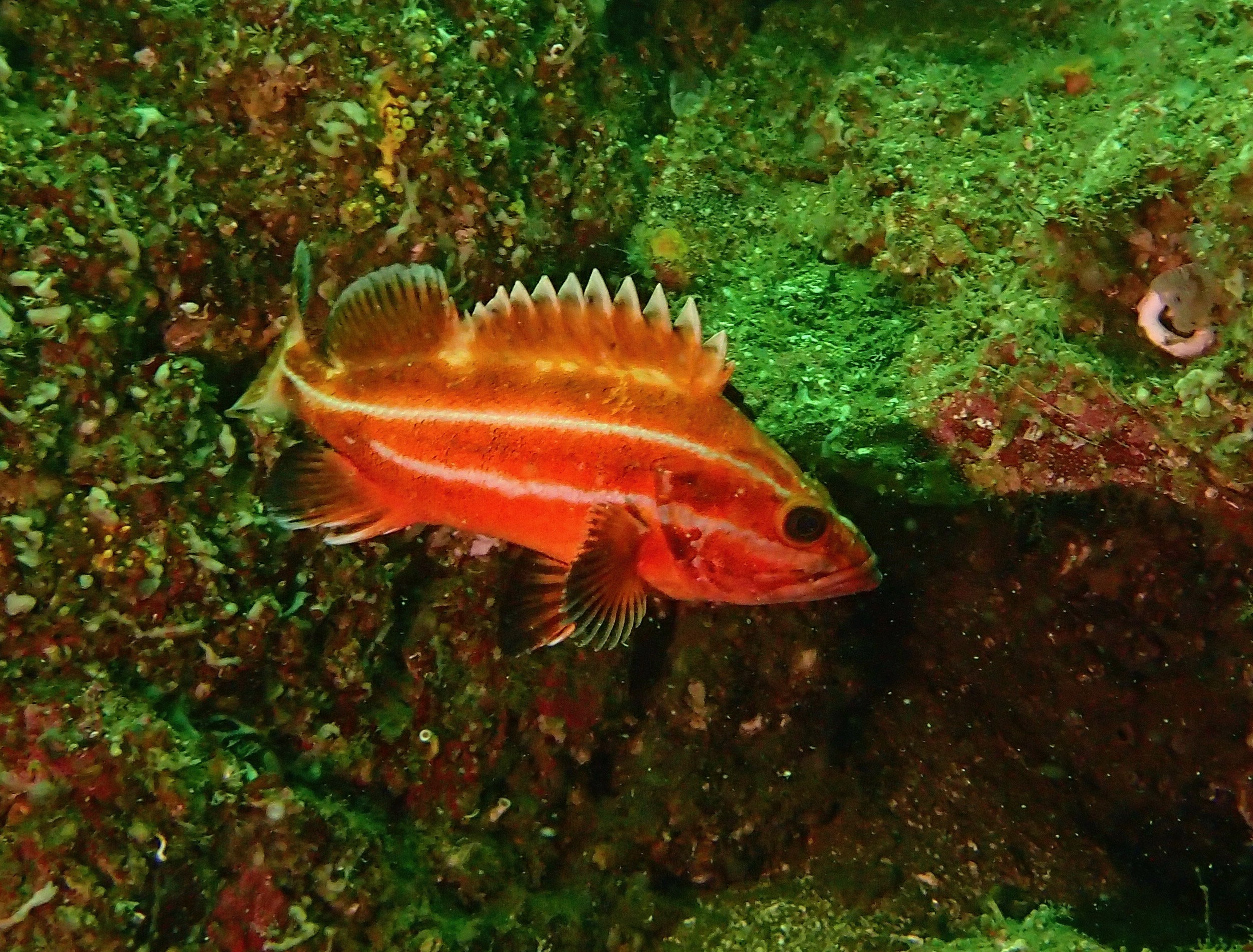
Yellow-eye rockfish (Sebastes ruberrimus) – Photograph by Don Gordon
Rockfish are a long-lived and diverse genus of fish in the Northeast Pacific, 11 of which are represented in the Galiano Island record. Species present include the threatened quillback rockfish (Sebastes maliger) and yellow-eye rockfish (S. ruberrimus), the latter of which is ranked as a species of special concern in Canada. This species may attain large sizes (~ 1 m, 12.6 kg). However, as with other species in the genus, it is slow to mature and reproduce and is, therefore, vulnerable to overfishing and fatality due to barotrauma from catch and release. As a consequence, many species of Sebastes are at low levels of abundance in the region. Spatially-managed rockfish conservation areas that remain permanently closed to all fishing and extraction activities are vital to ensure their recovery.
Community science contributions
Since the Biodiversity Galiano project began in 2016, our community has documented 66 fish species in the waters around Galiano Island, confirming 72 percent of the historical records and adding 11 new species to the list. Of the 76 historically reported taxa, 21 species remain unconfirmed, having gone unreported in the last twenty years.
Marine fishes dwell in various habitats, from deep sea (pelagic) to near-shore and intertidal environments. Taxa under-represented in this dataset include cartilaginous fish (chondrichthyes), hagfish (myxinids) and smelts (osmerids). These gaps reflect search efforts mostly biased toward rocky reefs and exposed beach locales, to waters < 30 m in depth. Poachers (agonids), right-eyed flounders (pleuronectids) and eelpouts (zoarcids) are also under-represented. These are primarily subtidal, soft substrate inhabitants, indicating that sampling has been limited in these habitats.
We can look to nearby records to get a sense for other species that may be expected locally. For example, the near-threatened bluntnose sixgill shark (Hexanchus griseus) is known from adjacent waters around Mayne Island, BC. This species likely occurs around Galiano Island, though it has not yet been reported locally.
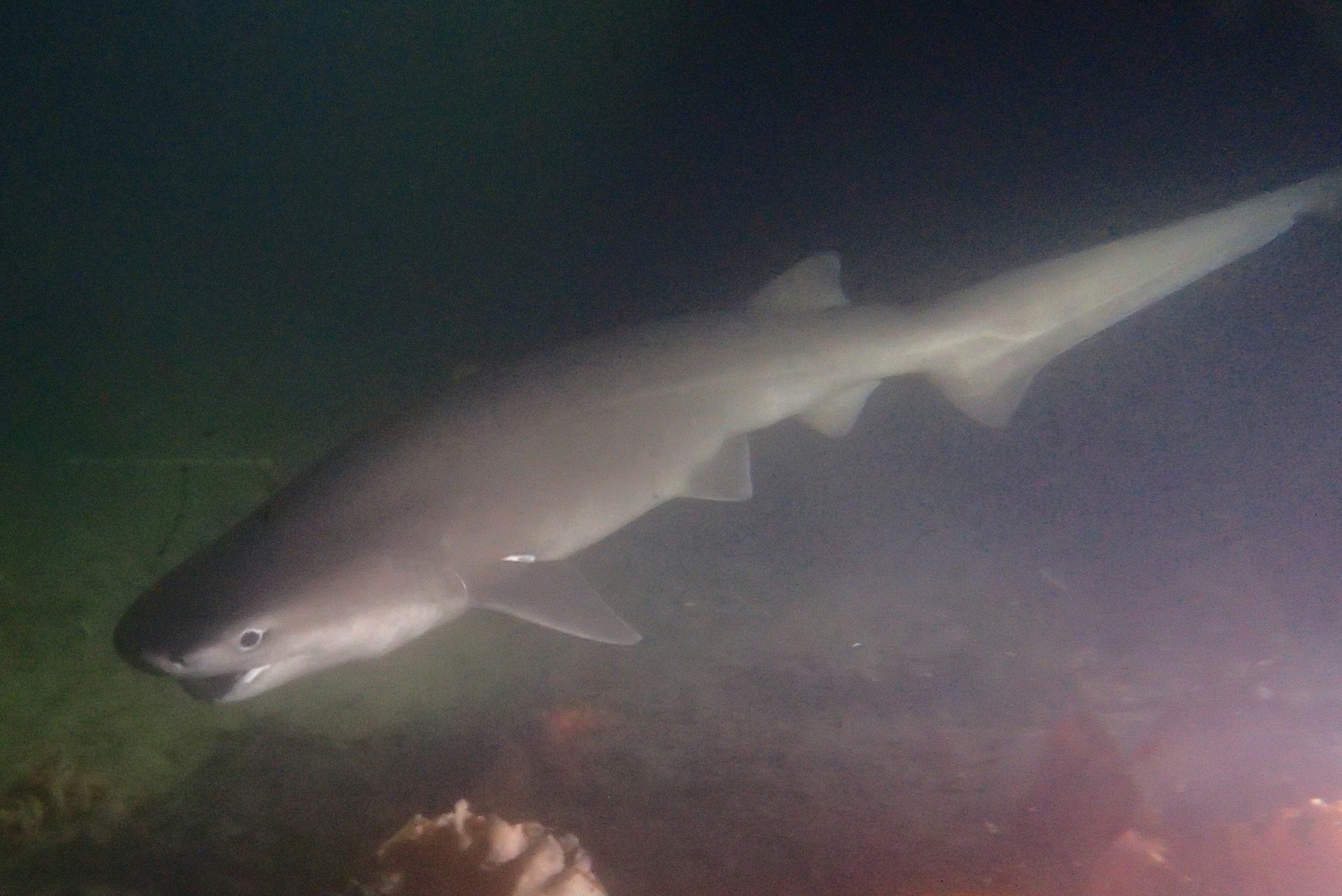
Bluntnose sixgill shark (Hexanchus griseus) – Photograph by Sara Thiebaud
Fish with Indigenous cultural significance
Fish are one of many phyla that have cultural significance to Hul’qumi’num speaking peoples, though perhaps the phyla with the most species to reference. Generally, fish are regarded as important food sources for delicacy and cultural practice.
Big Skate, known in Hul’qumi’num as Q’eq’o’, is often by-catch, being caught while fishing for other species in tidal flats (i.e. crabs or fish). Q’eq’o’ can be caught by hook and line or rake or gaff. Q’eq’o’ can be caught at night via gaff or spear in Clam Bay (Penelakut Island) and Shell Beach (Stz’uminus First Nation). They need to be cut immediately after harvesting, using a spear.
Black Rockfish, known in Hul’qumi’num as Syenyenhw, have three species and there are stories relating these fish to both history and practical cultural uses. Syenyenhw are good for eating as they are a rather fatty fish, despite being rather bony.
Spring Salmon (Chinook Salmon), known in Hul’qumi’num as Stth’a’qwi’, is one of the first salmon to begin their return to ancestral spawing grounds, thus, they have suffered severe overfishing and no longer arrive in spring for the spawning. Stth’a’qwi’ arrive to lay their eggs in the mid to late summer, spawning in the upper reaches of river systems. Smaller sized stth’a’qwi’ are preferred for their taste. Stth’a’qwi’ that have made the journey up river typically become dark or black in colour and are called si-ne’uts. Stth’a’qwi’ skin can be used for raincoats due to both it’s large size and waterproof properties.
Chum Salmon, known in Hul’qumi’num as Kw’a’luhw, are regarded as the eldest (suntl’e) of salmon species, being called kw’a’luhw for their tiger-striped stage or appearance change when they enter the freshwater river system from the ocean. Kw’a’luhw are called xi’le’ts as when they are at the stage where their scales begin to fall off, signifying the time when they are ready to be made into a delicacy. Kw’a’luhw are a preferred species for smoking despite being less rich than other species.
Coho Salmon, known in Hul’qumi’num as The’wun, return to their ancestral spawning bed, with three runs happening in the year in December, March, and April. However, in recent history, both the March and April runs are becoming extinct. The’wun are an important food resource in the winter when it is harder to catch fresh salmon, hence the runs become an important event for food access. The’wun is one of the richer salmons species and is also typically smoked.
Pink Salmon, known in Hul’qumi’num as Haan, only live 2 years, with only 6 months spent swimming to return to their freshwater spawning grounds. Haan is less rich than other species but easier to preserve. Haan are not a commercially viable species due to their difficult processing technique and the ability of their meat to rapidly become mushy and soft. Once rare in the Cowichan River, they are now abundant.
English Sole, known in Hul’qumi’num as Lhumuq’e’, (also referred to as Puli’hwus’ which means high-coloured head or hair) are typically caught by spear or by catching them barefoot by wading into the water shallows and holding them down. They can be used as bait to catch larger fish.
Starry Flounder, known in Hul’qumi’num as P’uwi’, is an important food source, caught at times when salmon is less available. P’uwi’ can be caught with a spear or hook and line.
Kelp Greenling, known in Hul’qumi’num as Tth’umuqwa’, can be used for food or bait, depending on personal preference. Tth’umuqwa’ are typically caught via spear by breaking sea urchines open underwater to serve as bait.
Lingcod, known in Hul’qumi’num as ’Eeyt, were once an abundant and well harvested species, with a special wooden lure (s-kewq-up) or live bait used to attract fish to the surface. They would then be thrown a spear from a canoe or the shory to collect them. They can also be collected by reef net or line fishing. The eggs of lingcod, known in Hul’qumi’num as Xuy’xuy’tl, are typically found in depths of 3-5 metres, with males guarding eggs in nests created from December to March. Only a portion of eggs are harvestedin, using a 3-pronged spear (shtl’e’lhunum’) to collect a variety of seafood. People with special knowledge use xuy’xuy’tl to predict the weather.
Pacific Herring, known in Hul’qumi’num as Slhewut’, maintain transient and resident populations. In early spring, slhewut’ spawn in large schools where one can see the white clouds in the shallows. Seabirds, eagles, and sea lions aggregating can be important indictors for slhewut’ and their spawn. Slhewut’ are an important food resource and are often smoked by hanging them on a stick like bananas.
Striped Seaperch, known in Hul’qumi’num as Wiitsi’, is one of the largest species in the perch family of fish. They are often caught by beach seine nets near rocky shores or gravel beaches.
Top community contributions to our knowledge of the island fish diversity
Here, you can browse photos of fish species commonly documented around Galiano Island, as well as recent observations, most favourited observations, and top observers, based on iNaturalist data. Please help contribute to the growing record of the island fish diversity by submitting your observations to the Biodiversity Galiano iNaturalist project.