
Apotreubia nana
| Common Name | None "The Treubster" |
| Quick & Dirty ID | White-Dotted Roid Lettuce |
Image Gallery


Distinguishing Features
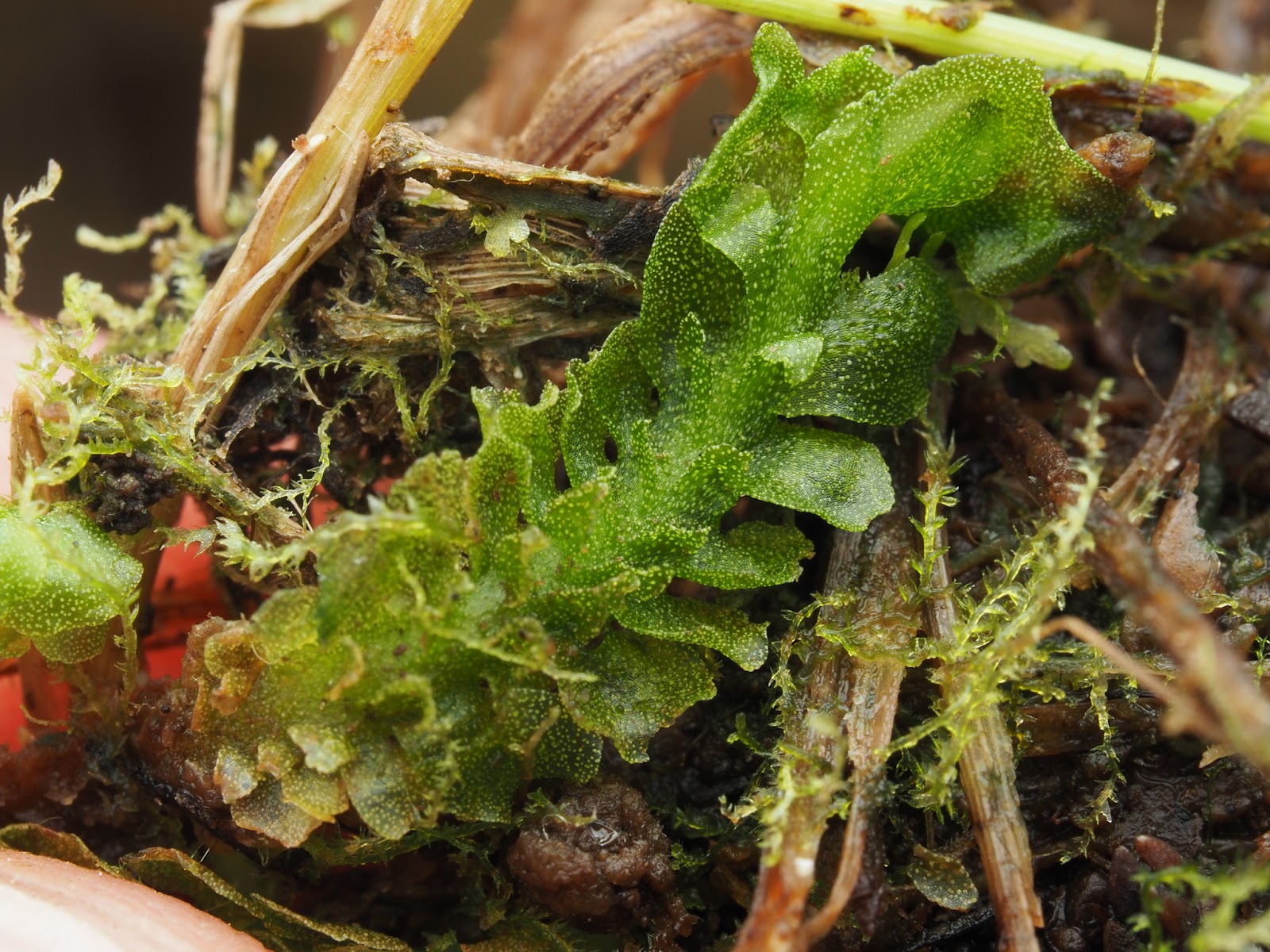
Apotreubia nana is a rare species of exceedingly wet coastal regions, where it can grow to 1.5 cm long and 5 mm wide on decaying organic matter and peat. It is a white-speckled plant that seemingly straddles the boundary between leafy and thalloid liverwort on account of thick, succulent leaves. The leaves themselves are of two sizes, both broadly and irregularly ovate, that seem to emerge from a common thallus-like tissue. The prominent white oil bodies can be seen at the surface with the naked eye and are diagnostic for this species in the region.
Similar species
The leafy liverworts Schistochilopsis incisa, Heterogemma laxa and species of Fossombronia can all exhibit irregular leaves that ride the boundary between thallus and leaf, but none of those species have the white, macroscopic oil bodies that are visible along the surface of A. nana.
Habitat
Moist to wet humus, rock outcrops, cliffs, bogs (among sedges in drainages), and occasionally decayed wood in the lowland zone in hypermaritime regions along the open coast.
Associated species
Sphagnum sp., Scapania uliginosa, Mastigophora woodsii, Herbertus sp., Pleruozia purpurea, Dicranum undulatum, Hookeria lucens
Distribution Map
Relevant Literature
- Godfrey, J.D. (1977). Hepaticae and Anthocerotae of southwestern British Columbia . [Doctoral dissertation, University of British Columbia]. UBC cIRcle.
- Hong, W. S. (2007). Scapania. In Flora of North America Editorial Committee (Eds.), Flora of North America North of Mexico (Vol. 3) . Oxford University Press.
- Wagner, D. H. (2013). Guide to the liverworts of Oregon: Scapania undulata . Oregon State University Herbarium.